Auto Kanban
A capture-first board for agent-driven work. Every request and every mid-turn discovery becomes a card before the agent acts, so nothing scrolls out of context and quietly disappears.
What it is
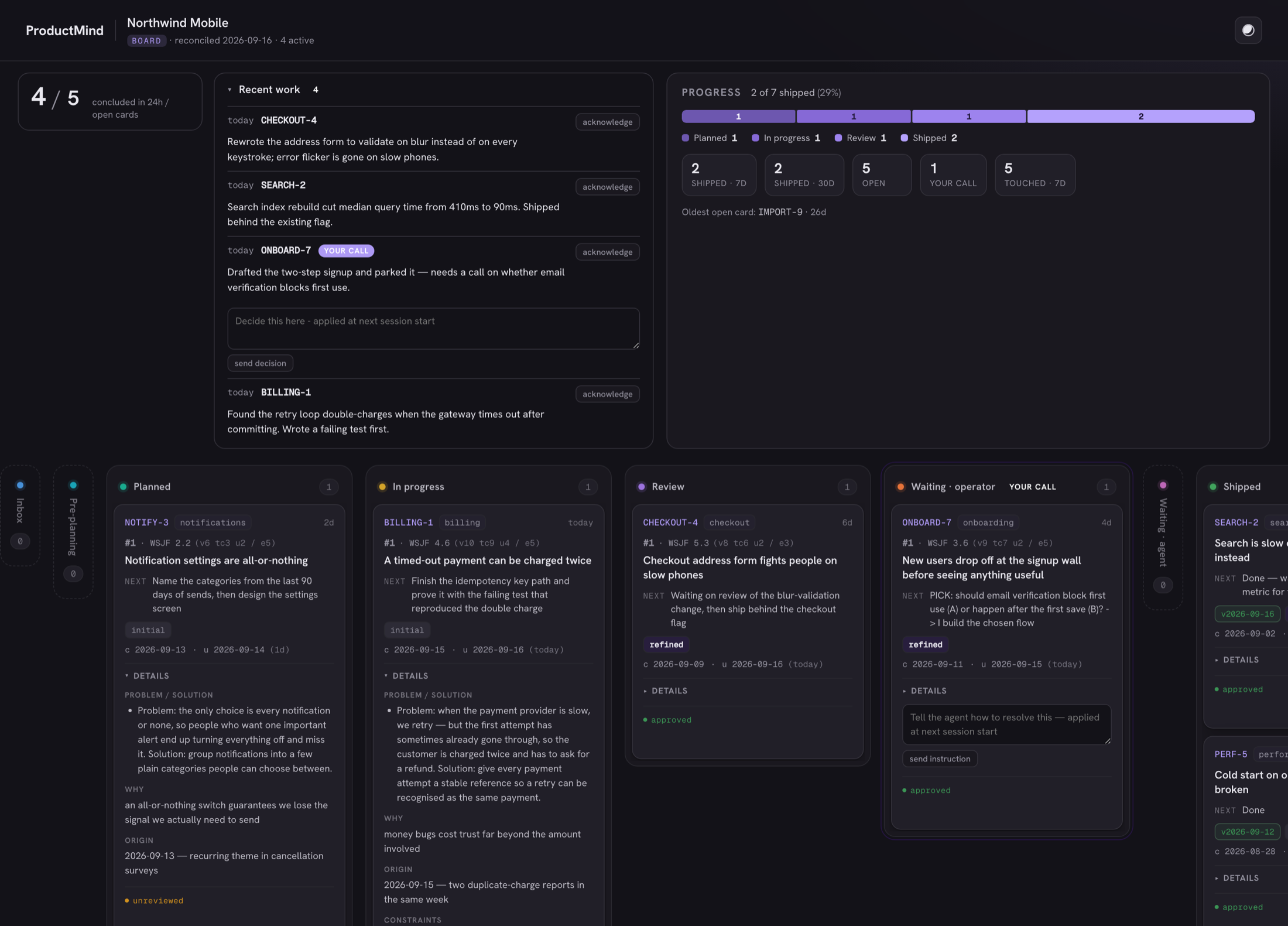
One YAML file is the source of truth. Markdown and HTML views render from it, and the release script marks cards shipped as part of the deploy flow, so the board can never quietly rot behind the code. The rule underneath it is simple: every user push and every idea the agent floats mid-turn becomes a card in the same turn, before acting on it.
Why we built it
An AI agent's working context is not a database. As a session runs, the context compresses: decisions tend to survive, but texture does not. The exact phrasing of a request, a constraint stated in passing, an option you explicitly rejected, the message an item came from. So a user's aside disappears, a rejected option comes back three sessions later as a fresh proposal, and a bug the agent noticed inside a tool result never gets acted on. The fix is not better memory. It is a different rule: capture first. Once an item is a committed card, it survives compaction, restarts, and model swaps. The transcript can decay. The board cannot.
How it works
The board is a work queue, not a status display. Every card carries a plain-language problem and solution written for a reader who was not in the room, plus where it came from and what was rejected, so a plan built from the board keeps the full context instead of a summary of a summary. A computed ranking sorts each lane, so the top card is always the next thing to pull. The human drives it while the agent is offline: done, deferred, and declined buttons queue an instruction the agent applies at the next session start, with the ship gate refusing to deploy until the cards being shipped are named. The board, not a chat log, is where the work lives.